




In Conversation With
Harry Hoblin & Tom Dawson at Charleston
Where Art Continues into the Garden
In the rolling landscape of East Sussex lies Charleston, a place where art, gardening and everyday life have been intertwined for more than a century. Once the home of artists Vanessa Bell and Duncan Grant, the house and garden became a meeting place for the Bloomsbury group and a space where creativity was allowed to move freely between indoors and out.
Today, Head Gardener Harry Hoblin and Assistant Head Gardener Tom Dawson are continuing that story. Harry has worked at Charleston for seven years, while Tom joined the garden around a year and a half ago. Together, they care for its history while allowing the garden to keep evolving, with an ecological approach, a willingness to experiment and, particularly in spring, an abundance of bulbs.
When Victoria Skoglund visited Charleston, the garden was at one of its most fleeting moments of the year. Apple trees were beginning to blossom, tulips filled the borders, camassias were emerging beneath the trees and forget-me-nots spread blue through the fresh spring green.

There is a close relationship between the house and garden at Charleston. Plants spill onto the paths and are allowed to grow right up against the house.
How do you approach the transition from winter into spring here?
Harry: Gradually, I suppose. And then suddenly.
There are so many plants here that naturally bridge the gap between the seasons. Snowdrops, daffodils and snake’s-head fritillaries begin appearing, and then suddenly everything starts happening at once.
We actually garden all year round. I tend to think of November as the beginning of the gardening year rather than January. In September and October there is still so much flowering here, and then you begin preparing for what comes next.
The winters are changing too. They are generally warmer, so rather than the garden completely disappearing, it often feels as though much of it simply becomes dormant.

Tell your brand's story through images.
Bulbs play an important role in the garden. Do you plant them with a long-term vision, or do you allow them to evolve more freely?
Harry: We’ve inherited a lot of bulbs in this garden, so there is always a balance between managing what is already here and introducing something new.
The camassias, for example, grow beautifully underneath the fruit trees and are really well suited to growing in a meadow. We also have snake’s-head fritillaries and many other bulbs that have become part of the garden over time.
Some things can become a little too enthusiastic, so every year we thin certain bulbs out quite dramatically. But I like that element of not completely knowing what will appear.
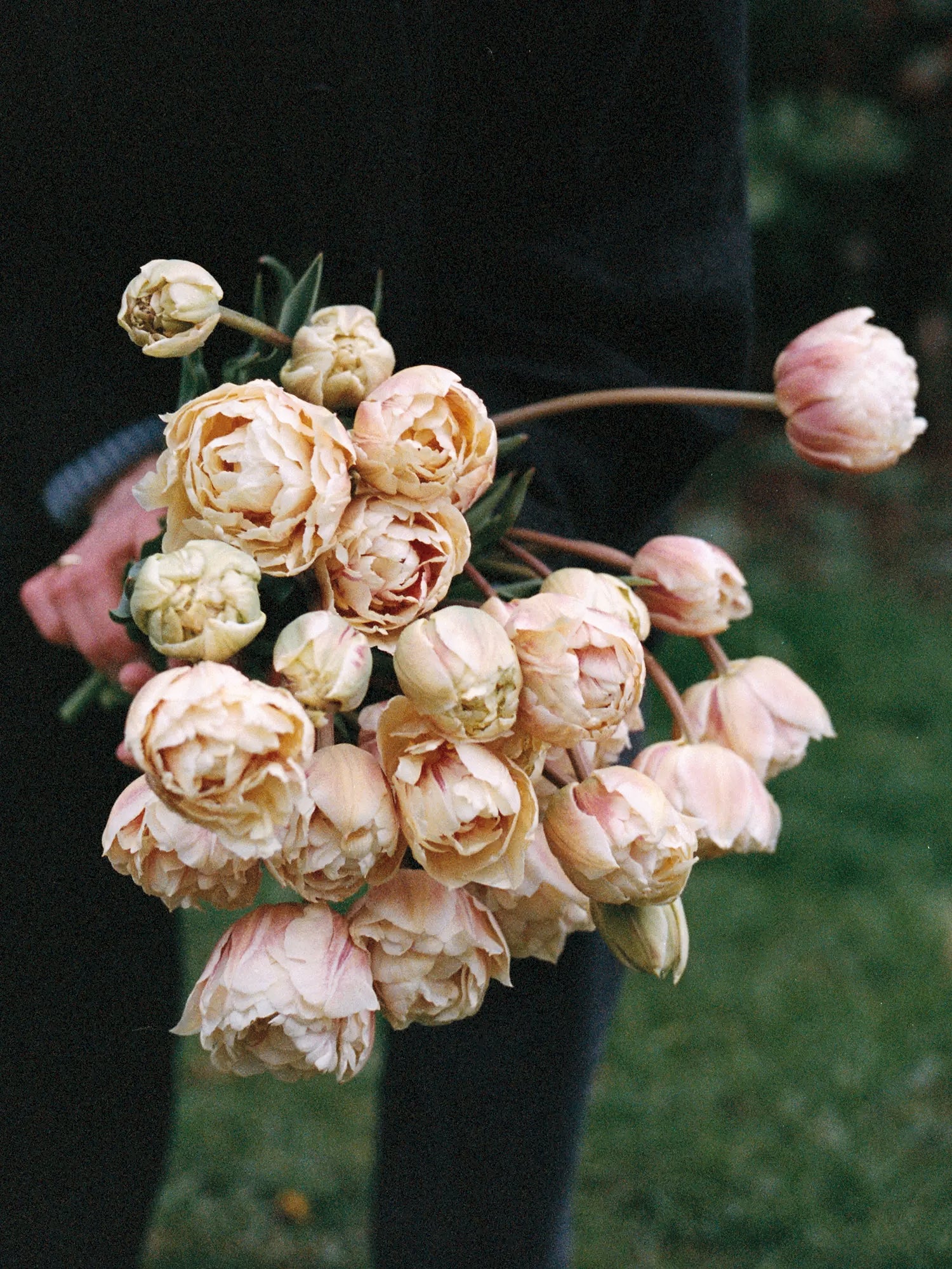
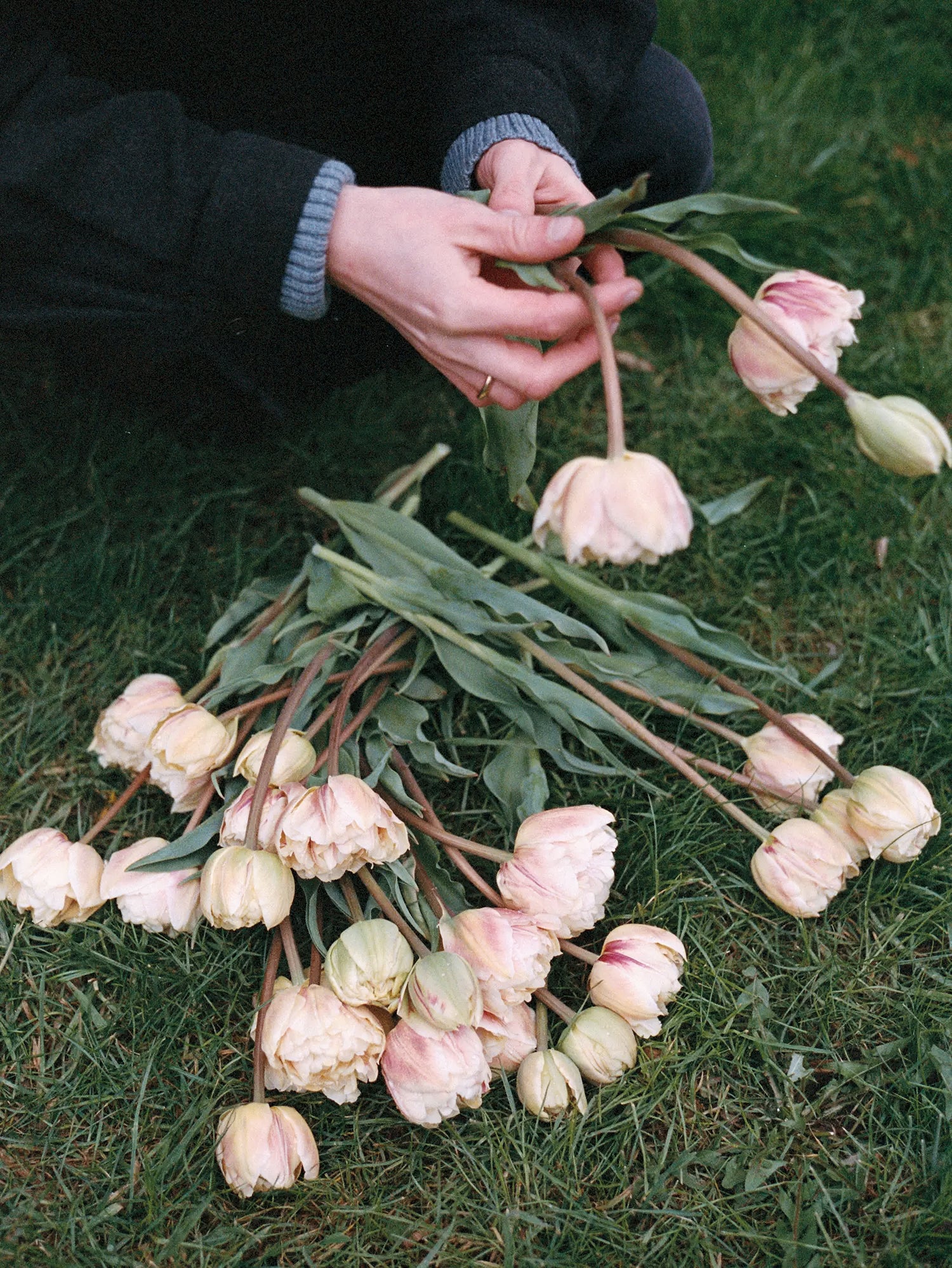
With the tulips, we choose a few hundred bulbs each year for our display bed. Those are selected specifically for that season. Once they have finished flowering, we lift them and plant them out into the meadow, and the display bed is replanted with dahlias and cosmos.
In the more naturalistic borders, amongst perennials and biennials, we tend to leave most of the tulips where they are and simply see what comes back the following year.
So there is room for the garden to make some of its own decisions?
Harry: Definitely. I think I’ve become more laid-back the longer I’ve worked here.
Sometimes the instinct as a gardener is to intervene immediately, to cut something back, move something or tidy it up. But increasingly I’m interested in seeing what happens if we don’t.
It’s about finding that balance.

Do you have a favourite bulb in the garden?
Harry: I love the clumps of snake’s-head fritillaries here. And I have to say, I like yellow in a garden. Some people don’t, but I do.
At the moment we have two tulips called ‘Green Mile’ and ‘Flashback’ growing with the Dutch iris ‘Apollo’. Around them there is purple honesty, angelica, cow parsley and lots of emerging foliage.
For me, it’s about having that mixture. We introduce wilder plants that we know pollinators will appreciate, but we still want those classic cottage-garden favourites and big, blousy bulbs too.
Everything is about diversity.

The tulips find their place among what is already growing. A mix of colour, form and fresh spring greenery that changes from year to year.
Vanessa Bell used the expression “sweet disorder” when describing the garden. What does that mean to you?
Harry: It’s this idea of a medley of different plants.
You have fruit trees, but then hollyhocks and dahlias are growing through them. Plants spill out onto the paths and different scents move through the garden.
Vanessa wrote about the scent of plants such as night-scented stocks, nicotiana and dianthus. I like to imagine the French doors of the house being open throughout the summer and all those scents drifting inside.
There is this symbiotic relationship between the house and the garden.

Harry Hoblin among the spring plantings. Over the years, he has become increasingly curious about what happens when the gardener sometimes chooses not to intervene.
And are you fond of scented flowers yourself?
Harry: Yes. I love putting my nose into something!
Before the tulips, we had hyacinths in the pots here. Every time I walked across the piazza you could smell them.
We also have lots of roses. Scent is definitely an important part of experiencing a garden.
There seems to be a mixture here between ornament and things that are useful or edible.
Harry: Yes, particularly in the old kitchen garden. Historically it was a Victorian kitchen garden, so it would have been used for growing vegetables and fruit.
We still have apples, pears, rhubarb, gooseberries and currants, but they sit amongst hollyhocks, foxgloves, herbs and other ornamental plants.
With the fruit trees, I also like looking for local and historic varieties from Sussex and Hampshire. England historically had thousands of different apple varieties, and it feels important to keep some of that tradition alive.

Your work here also has a strong ecological approach. How does that influence the way you garden?
Harry: Ecology and the environment have always been important to me. Before becoming a gardener, I worked in small-scale organic vegetable growing.
But I think our approach here is becoming even less interventionist. We cut things back later, we leave more material in the borders and we think more about the habitats we are creating.
This winter, for example, we’ve been building dead hedges rather than having bonfires. Instead of burning material, we use it to create habitat piles around the site.
Tom: For me, it’s also about working with what is already here.
There are lots of different habitats and conditions around Charleston, so we’re looking at which wildflower species can naturally thrive in those places and how we can encourage them.
It isn’t about making everything wild. It’s about increasing biodiversity in a way that still feels like Charleston.
Has climate change affected the way you choose plants?
Harry: Yes. There has been a big movement in Britain towards drought-tolerant planting, but the challenge is that a plant also needs to survive our increasingly wet winters.
We seem to be moving towards something more like two seasons: a very wet season and a dry season. When it rains, it can rain incredibly heavily, and when it becomes hot, things can dry out very quickly.
We are fortunate because many of the plants Vanessa Bell and Duncan Grant chose already have a Mediterranean character, such as cardoons, artichokes and other plants that tolerate dry conditions quite well.
So now we have to find plants that can cope with both extremes.

Vanessa Bell and Duncan Grant approached Charleston very experimentally. How do you carry that spirit forward while caring for a historic garden?
Harry: It is still, and always will be, Vanessa and Duncan’s garden.
We have to respect the heritage of the space. There should always be fruit trees here, always roses, and plants such as cardoons, artichokes, hollyhocks, red-hot pokers, sea holly, globe thistles, tulips, poppies, dahlias and zinnias all belong to its story.
Sometimes it almost feels as though you’re gardening with them.
But we are also gardening in the 21st century. We can be experimental in ways that are more ecologically focused, while still trying to understand their mindset.
Tom: That’s one of the things I love about working here. It’s an artist’s garden.
Because of that, I think there is room to experiment. We want to preserve the feeling of Charleston without becoming completely tied to the past.
The house and garden have this very special relationship. The decoration almost seems to continue from inside the house and out into the garden.
And despite how much is happening here, the walled garden is actually quite small. It has a domestic scale. People come here and want to paint, draw, take photographs and be creative.

In Charleston’s garden, the boundary between art and nature is rarely clear-cut.

Victoria Skoglund in conversation with Harry Hoblin, Head Gardener at Charleston, about bulbs, biodiversity and the courage to loosen some of the rules of gardening.
If visitors could take one idea or feeling away from Charleston, what would you hope it would be?
Harry: A sense of freedom and exuberance, and the confidence to try things simply because you like them.
It’s very easy in horticulture to become tied to traditional ways of doing things: this plant shouldn’t grow next to that plant, this needs to be cut on a particular date.
For me, experimenting and trying things is part of the joy.
Tom: I would say the same. Be brave and experiment.
There are lots of rules in horticulture that we’ve been told exist, but you don’t always have to follow them. You don’t have to grow a particular colour with another colour simply because someone says so.
At the same time, there should be respect for the garden, its history and horticultural tradition.
But above all, gardens should be enjoyed. Gardens are as much about people as they are about plants. In some sense, we’re all gardeners, whether we have a garden or not.
Spend time with the plants and the birds. Take moments to pause and notice what is happening around you.
That is part of gardening too.

Organic Bulbs for a Flowering Spring


The interview took place at Charleston in East Sussex on 14 April 2026. Victoria Skoglund in conversation with Harry Hoblin, Head Gardener, and Tom Dawson, Assistant Head Gardener.
